Open source (MIT) · built on CLIProxyAPI
One key for every AI account.
A self-hosted AI gateway: one OpenAI-, Claude- and Gemini-compatible endpoint for your API keys and accounts, with the prompt cache kept in use and the account behind every answer shown.
Your subscriptions and API keys behind one endpoint, open to everyone you choose. Run it on your own machine or on a server your team shares, give each person their own client key, and point their tools at it.
macOS and Linux with Homebrew; Docker, release archives and source too. An existing CLIProxyAPI setup works as it is.
What Provimux adds to CLIProxyAPI
Each Provimux release is a CLIProxyAPI release with Provimux's changes on top. It reads the same config.yaml, auth folder (~/.cli-proxy-api) and port (8317), so an existing CLIProxyAPI setup works as it is: stop CLIProxyAPI and start Provimux in its place.
Cache You pay for a prompt once and read it after that.
OpenRouter
CLIProxyAPIA Claude-format client's cache markers are lost in translation, and a client that sends none gets none, so every such request pays for the whole prompt. Every model gets the same generic limits and the levels low, medium and high.
ProvimuxCache markers added where the client sent none, a 1-hour lifetime kept through translation, one upstream per conversation (X-Session-Id) so the cache keeps being read, and each model's real context window, output limit and reasoning levels. Any openai-compatibility entry on openrouter.ai gets it.
The prompt cache on OpenAI API keys
CLIProxyAPIprompt_cache_options is removed for every Codex credential, API keys included.
ProvimuxA client's prompt_cache_options.ttl (for example "12h") is forwarded on an OpenAI API key. Subscription logins are unchanged.
A Codex WebSocket replay
CLIProxyAPIA client that sends its whole conversation again has it merged with the previous turn: the model sees the conversation twice, and the request is billed at about twice the input.
ProvimuxThe conversation is answered as it was sent, not merged.
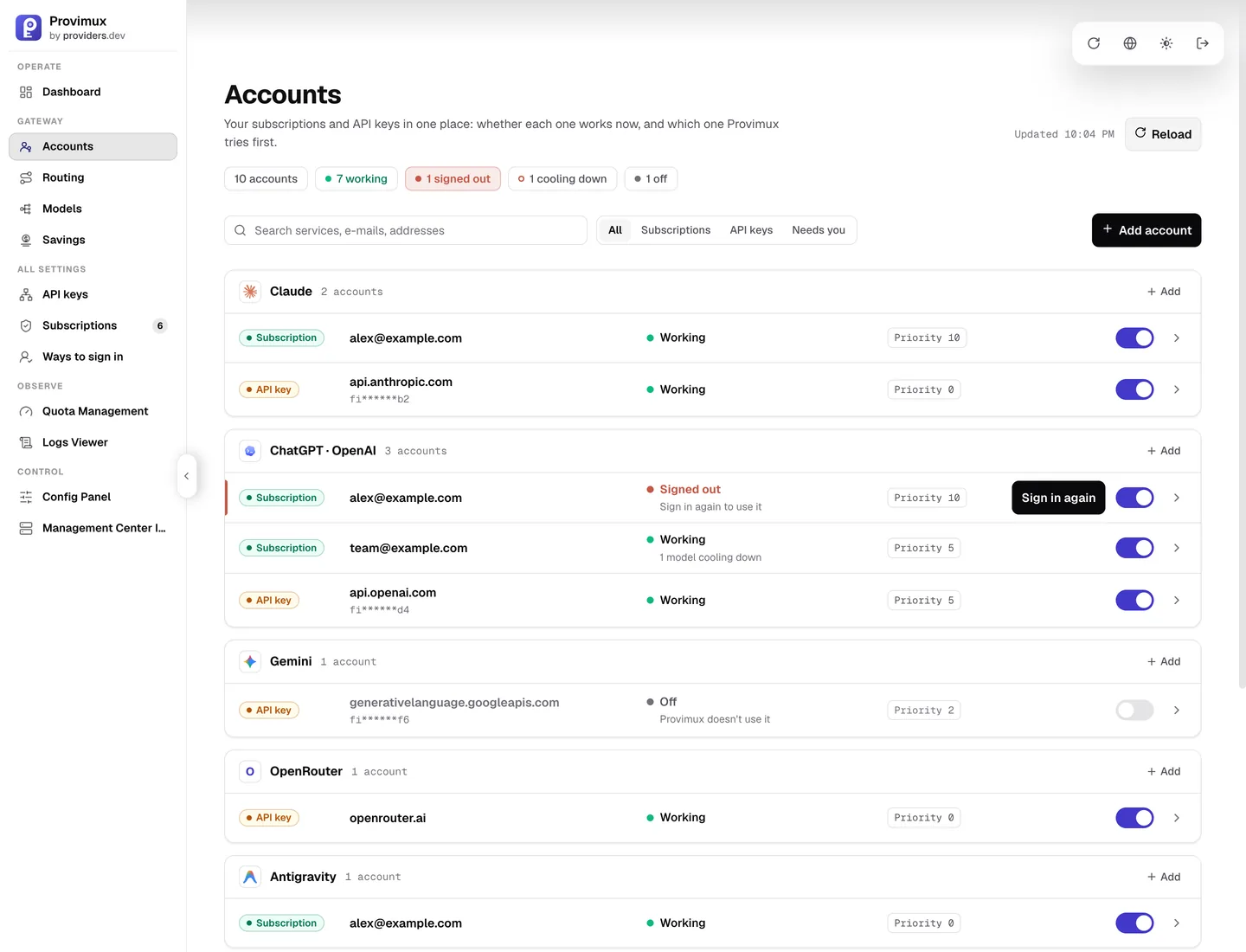
Clarity You see which account has which models, which one answered, and why a route is paused.
Which account answered
CLIProxyAPIA client behind the proxy sees one list of models and cannot tell which account it is using.
ProvimuxThe model list names the accounts behind each model, highest priority first (/v1/models?include=accounts), and every response names the one that answered (X-CPA-AUTH-KIND, X-CPA-AUTH-PROVIDER, X-CPA-AUTH-HOST).
Each login's own model list
CLIProxyAPIClaude, Codex, Meta and Devin logins and Gemini API keys offer the shared catalog, which is edited by hand: it can list a model a day late, keep a retired model that then answers 404, or list a model your plan is refused.
ProvimuxEach of them offers what its own account lists: retired models disappear, and new ones appear the day the provider lists them. On by default (models.live-lists).
Limits of the models you configure
CLIProxyAPIAn alias of claude-opus-5-5 on a Claude API key reports a 500,000 context window and no output limit (CLIProxyAPI 8.0.77, Codex-format model list).
ProvimuxThe same alias reports 1,000,000 and 128,000: the limits of the catalog's model it points to.
Devin
CLIProxyAPIEvery model is listed and enforced at 64,000 output tokens, and a quota that runs out pauses the whole login.
ProvimuxEach model's own output limit (for example kimi-k3 131,072), with --local-model or a list you generate; and, when you switch it on, a quota pause on the refused model only.
The console
CLIProxyAPIThe CLI Proxy API Management Center.
Provimuxprovimux-ui: the same console in the providers.dev look, with Provimux's own pages Accounts, Models and Savings. Provimux downloads it and installs it only when it matches the release's checksums.
Everything else is CLIProxyAPI's. The logins, the providers, the translation between formats and the routing are its work. The requests Provimux sends to providers are CLIProxyAPI's, except where a row above says otherwise, and providers see the same client version as with CLIProxyAPI.
Releases follow CLIProxyAPI's. A workflow checks for a new CLIProxyAPI release every 3 hours, moves Provimux onto it, builds and tests it, and publishes it on its own when the check passes; a release that fails a check waits for the maintainer. A version names its base: v8.1.2-pmx.1 is CLIProxyAPI 8.1.2 with Provimux build 1. Latest release
The console
provimux-ui is CLIProxyAPI's Management Center in the providers.dev look, with Provimux's own pages. Nothing to install: Provimux downloads the latest release at startup and every 3 hours, and installs it only when it matches the release's checksums.txt.
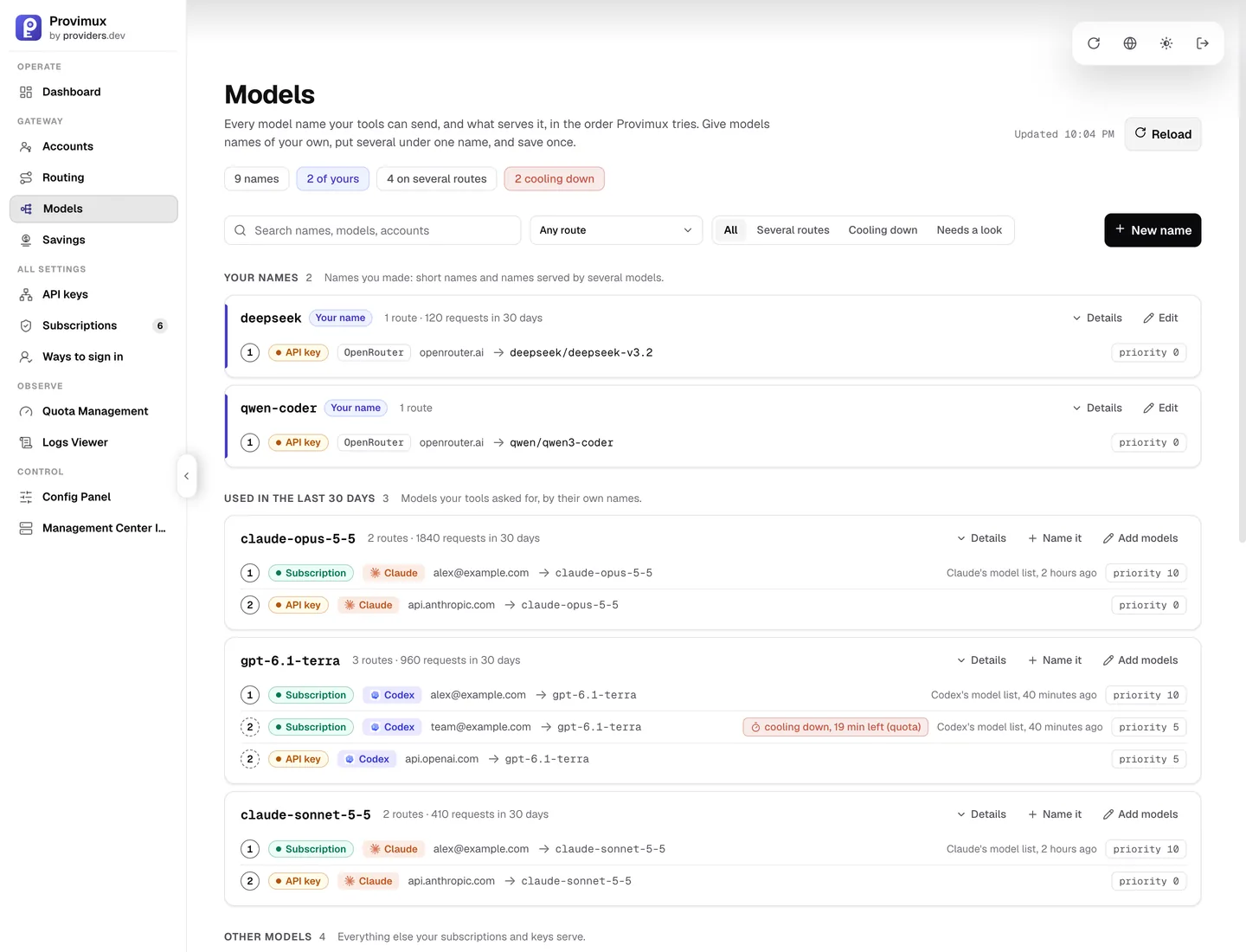
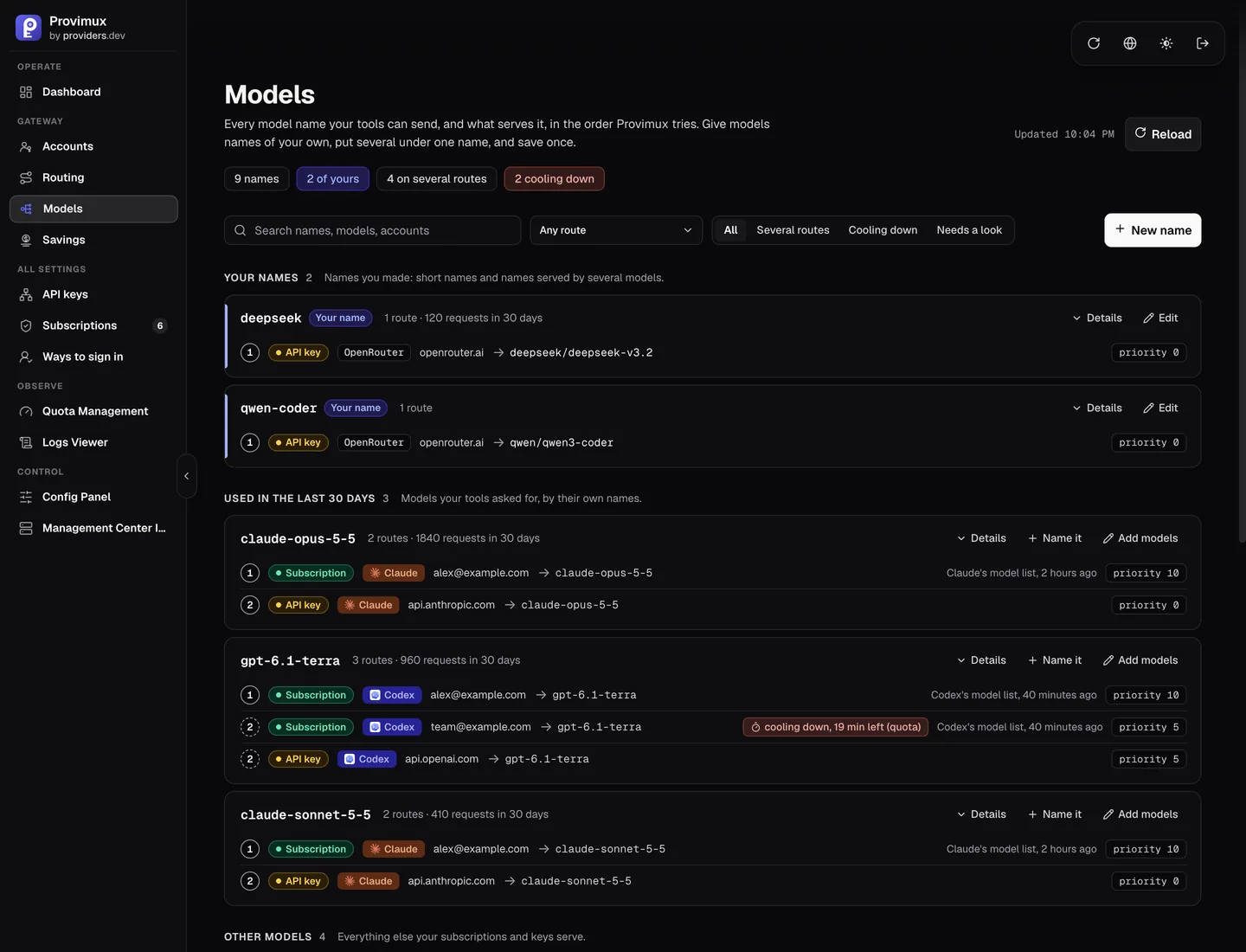
- Models. Every model name your tools can send, and what serves it, in the order Provimux tries: subscription or API key, the account, the model sent, its priority, a recorded cooldown and the age of each login's own list.
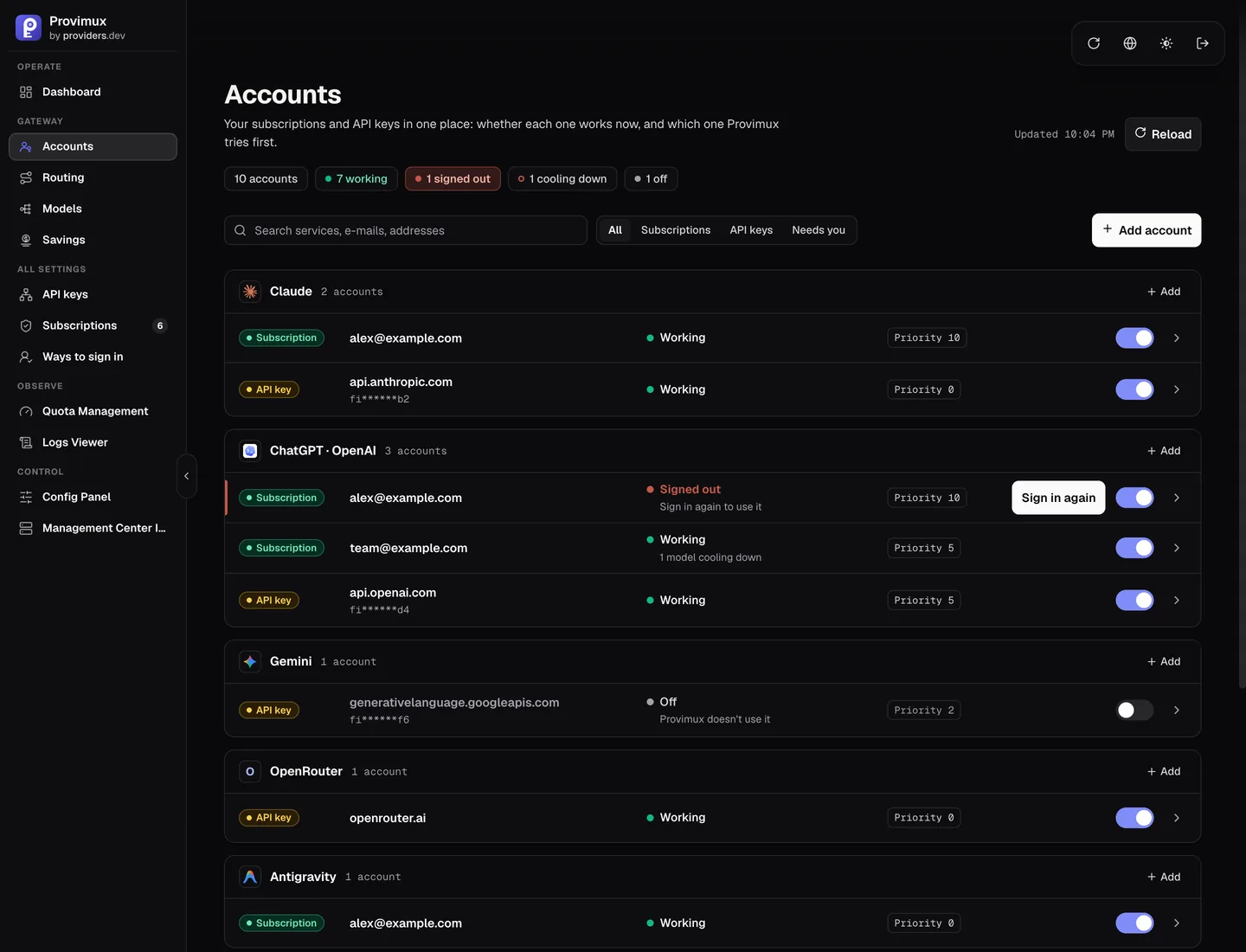
- Accounts. Every subscription and API key on one page, one card per service, each with its state in one word (Working, Signed out, Cooling down), its priority, and the fix where one is needed.
- Your own names. Short names, and one name served by several models, saved in one action.
- Savings. Daily usage totals kept across restarts and estimated at public list prices: what prompt caching was worth, and what the paid keys cost.
Install
With Homebrew on macOS (Apple silicon and Intel) and Linux (x64 and Arm), from the tap ngvoicu/homebrew-tap:
brew install ngvoicu/tap/provimux
brew services start provimuxThe config is $(brew --prefix)/etc/provimux.conf, created on the first install and never overwritten. Then open the console at http://127.0.0.1:8317/management.html on the same machine (from another machine, use the server's address) and sign in with your management key, management.secret-key in the config.
Coming from CLIProxyAPI with Homebrew
Stop its service (both listen on port 8317) and point Provimux at its config:
brew services stop cliproxyapi
ln -sf "$(brew --prefix)/etc/cliproxyapi.conf" "$(brew --prefix)/etc/provimux.conf"
brew services start provimux
Other ways
- Docker:
ghcr.io/ngvoicu/provimux, linux/amd64 and linux/arm64, with CLIProxyAPI's paths: a CLIProxyAPIdocker-compose.ymlworks with only the image name changed. - Release archives for macOS, Windows, Linux and FreeBSD, each release with its
checksums.txt. - From source, with Go.
For a team
Run it on a server the team can reach and point everyone's tools at http://<your-server>:8317. Each person gets their own client key under access.api-keys; removing it shuts out only that person. Outside a network you trust, serve HTTPS.
Your accounts
Add API keys under api-keys: claude, codex (OpenAI), gemini, vertex, xai, meta, and openai-compatibility for OpenRouter and other OpenAI-compatible services. For a company, use API keys and cloud accounts (for example Vertex), billed to the company under its own agreement with the provider.
Provimux also accepts subscription logins (oauth) for your own account. Whether a provider allows a third-party tool to use its subscription login is that provider's decision: Anthropic's terms do not allow it, and OpenAI has not authorized it. Read your provider's terms before you add a login; the account is yours and so is the risk. Provimux is not affiliated with or endorsed by Anthropic or OpenAI.
For pi
pi-provimux
Provimux's extension for pi. It adds Provimux as a provider in pi, provimux, and works the same with plain CLIProxyAPI: every model your server serves appears in /model, with its context window, reasoning levels and, when models.dev knows it, its price.
- Where each model comes from, in its name:
Claude Opus 5.5 · Anthropic sub, fallback api.subis a subscription login,apian API key. - Which route answered, in the footer, after each answer:
answered: Anthropic sub. This needs Provimux 8.1.1-pmx.1 or newer. - Claude models in Claude's own format (
/v1/messages) where it is safe: with pi's long cache retention, that brings Anthropic's 1-hour prompt cache.
pi install npm:pi-provimuxThen, in pi, run /login Provimux and enter your server's address (for example http://127.0.0.1:8317) and your client key. It needs pi 1.6.0 or newer.
pi-provimux on npmSource on GitHub
A fork of router-for-me's pi-cliproxyapi-provider.
/model
→ claude-opus-5-5 (Claude Opus 5.5 · Anthropic sub, fallback api) [provimux]
  gpt-6.1-terra (GPT 6.1 Terra · OpenAI sub, fallback api) [provimux]
  anthropic/claude-opus-5.5 (anthropic/claude-opus-5.5 · OpenRouter api) [provimux]
footer answered: Anthropic sub
Support
Provimux is free and stays open source (MIT). For companies that run it, providers.dev offers support plans: a private channel to the maintainer and a first reply within a stated number of business days. A reply, not a promised fix.
Built on CLIProxyAPI
Provimux is built on CLIProxyAPI by Router-For.ME, started by Luis Pater. Nearly everything Provimux does is CLIProxyAPI's work: the logins, the providers, the translation between formats and the routing. Its console, provimux-ui, is the CLI Proxy API Management Center, also by router-for-me. Thanks to its authors and contributors.